




.avif)

.avif)

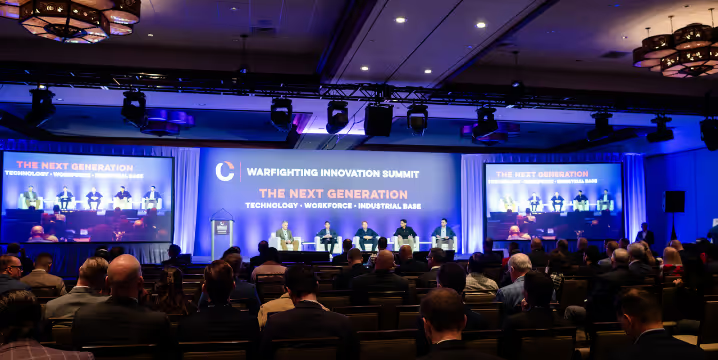
On February 20, the Creative Defense Foundation held the Warfighting Innovation Summit in La Quinta, CA, in partnership with FedTech.
Rather than treating innovation, capital, and acquisition as sequential conversations, the Summit brought them into the same room at the same time.
More than 300 leaders across operators, acquisition and transition offices, integrators, venture partners, and early-stage technology teams gathered to examine what it takes to move technology from development to fielded use.
Across a series of focused discussions, speakers examined execution ownership, integration dependencies, capital alignment, and acquisition realities, followed by showcases from the Winter 2025–2026 Crucible Ignitor and Accelerator cohorts, highlighting companies building deep tech solutions for the warfighter.
This February, the Summit served as an exclusive launchpad for emerging technologies to gain early visibility with key decision makers and tech transition stakeholders responsible for DoW and commercial applications.
The Future Battlefield — Emerging Technologies and Defending the Indo-Pacific
Moderator: Clay Duarte, Director of Special Projects, Defense and Commercial Innovation, FedTech
Panelists: Dr. Anshu Roy, CEO of Rhombus Power; Dr. Matt Willis, Director at Army FUZE; Tony Williams, Founder of National Security Accelerator Studio; and Chris Aliperti, Senior Instructor at the United States Military Academy at West Point.
The panel opened with a clear call for structural change: preparing the warfighter for future conflict requires a decisive shift in how the defense acquisition ecosystem evaluates, tests, and integrates emerging capabilities.
For cutting-edge technologies remain relevant to current battlefield conditions, active testing and rapid iteration need to be prioritized. In parallel, funding structures must support those timelines, giving startups flexibility as they scale and integrate new capabilities. Maintaining a competitive advantage will require bridging the gap between private capital and operational need, turning innovation into an integrated capability that reaches the warfighter faster.
Innovation in the Inland Empire: The Southern California Aerospace and Defense Coalition
Moderator: Justin McEwen, Defense and Commercial Innovation Project Lead, FedTech
Panelists: Kimberly Gibson, Industrial Base Integration Director of America Makes; Rahul Singh, CEO & Founder of Marshall Industries; Angel Sanchez, CEO of Phenix Technology, Inc; Raul Rodriguez, Advanced Manufacturing Technology Engineer at Northrop Grumman; and Erick Went, Director of Matter Labs.
The Inland Empire continues to serve as an engine of defense manufacturing, with a new generation of leaders building clearer pathways from innovation to acquisition. The startups on track to transition their technologies prioritize early engagement with program stakeholders, supply chain partners, and regional industrial base actors who influence integration and procurement.
Part of building the American advantage is building trusted partnerships across institutions, industry, and operators in the region — a key component to early planning and acquisition alignment.
The Real Lessons from Ukraine and Israel
Moderator: Matthew McGregor, COO, Creative Defense Network
Panelists: Greg Grant, Adjunct Senior Fellow at the Center for New American Security; James Gherdovich, Chief Strategy Officer at Grid Aero; Susanne Hake, EVP and GM for U.S. Government Business at Vantor; Matteo Shapira, Co-Founder and CXO of XTEND.
Drawing on lessons from active conflicts in Ukraine and Israel, this panel explored how modern warfare is reshaping defense innovation and how the private sector is contributing directly to capability development and deployment cycles. A shift is underway toward affordable mass, autonomous systems, and rapid iteration forged in real-world conditions.
Open, adaptable ecosystems are rewarded over closed platforms, prioritizing speed and system resilience. To maintain an advantage, the Department of War must move beyond traditional procurement and act as a market catalyst, driving domestic scale and enabling continuous adaptation.
The Adoption Gap - A New Approach to Startup Integration
Moderator: Ben Solomon, CEO, FedTech
Panelists: Sha-Chelle Manning, Chief of Commercial Strategy at DARPA; Marco Romani, Strategic Contractor, CACI; Colonel (COL) R. Clayton McVay, U.S. Army; Mike D’Onofrio, Tech Transition Advocate at the ARL Tech Transfer and Outreach Office; and Anthony Pugliese, Director at DOE Office of Commercialization.
As new federal acquisition guidance increasingly emphasizes measurable impact and rapid delivery, this session focused on why validated startup technologies still struggle to integrate into defense programs.
Panelists examined structural barriers that slow integration and highlighted emerging pathways and pilot mechanisms designed to accelerate adoption timelines. Closing the adoption gap demands a shift across the federal government to prioritize clearer ownership, earlier integration planning, and alignment across acquisition stakeholders.
Capital Pathways for Dual-Use Innovation
Moderator: Robyn Brazzil, COO, FedTech
Panelists: James Parker, Co-Founding Partner of Leonid Capital Partners; Karen Roter Davis, Managing Partner at Entrada Ventures; and Jesse Gipe, Director of Early-Stage Portfolio at the Defense Innovation Unit (DIU).
As investor interest in defense technology grows and SBIR uncertainty continues, alternative funding and contracting mechanisms are emerging from the Pentagon. Panelists highlighted aligning technical milestones, diversifying funding sources, and treating the Department of War as a customer with sustainment expectations to bridge the “valley of death”.
The Summit concluded with semi-final showcases from the Crucible cohorts, highlighting companies building Naval mission-aligned capabilities.
Ignitor Winner – Novos Power is modernizing how defense installations access and manage power. Their Variable Airgap Solid-State Transformer (VASST) system enables modular, rapid deployment at bases to deliver real-time voltage and frequency regulation during grid stress.
Accelerator Winner – WearableDose provides real-time radiation intelligence through a wearable, tissue-equivalent sensor paired with an AI-driven platform. The solution enhances situational awareness, safety, and decision-making for defense personnel operating in complex or high-risk environments.
Together, these winners reflected the Summit’s core objective: engaging operators, integrators, and decision-makers early in the lifecycle increases the likelihood that emerging technologies transition successfully—equipping the warfighter with the right capabilities to maintain advantage in future conflicts.
The Warfighting Innovation Summit was hosted by the Creative Defense Foundation, in partnership with FedTech, as part of Creative Disruptors in the Desert 2026.