Read the full transcript
Xiao Zhong (00:07)
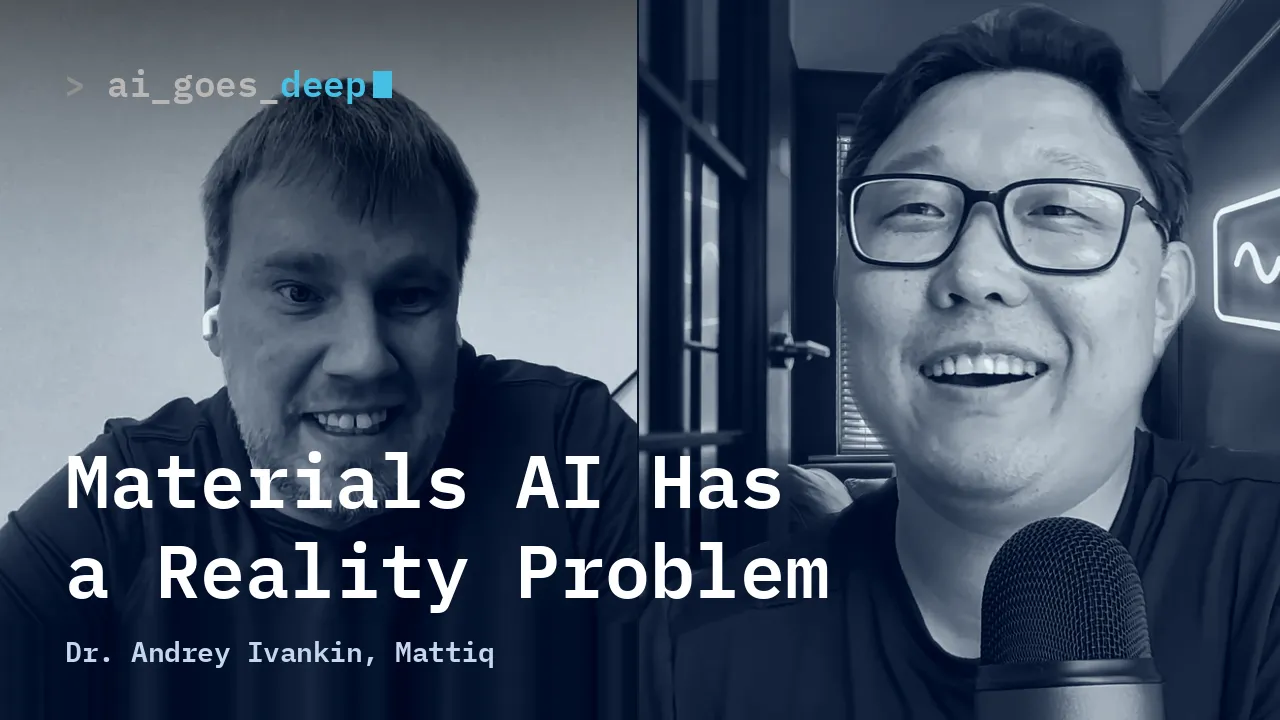
Welcome to AI Goes Deep. So this is a podcast hosted by FedTech, where we talk about really cool things that are happening in AI and deep tech. My name is Xiao. I'm the VP of Venture Building and Applied AI here at the company. So our today's guest here is Dr. Jehad Abed. Welcome to the show, Jehad.
Jehad Abed (00:29)
It's great to be here. Thank you, Xiao.
Xiao Zhong (00:31)
Yeah, I don't even know where to start introducing you. You've done a lot of great things here. So now maybe introduce yourself, please, and then tell us about your role here now at Google X and also before at Meta. This long trajectory of talking about the things that's relevant here to some of the previous episodes. We talked about AI, materials, self-driving and data.
Jehad Abed (00:55)
Yeah, my name is Jehad and I'm a material scientist. I have a PhD in material science and I've worked in this space for about more than a decade right now, researching different applications for inorganic materials specifically. So I'm an experimentalist. I spend my time at the lab bench making materials and investigating them, characterizing them, putting them in devices to test them.
Jehad Abed (01:24)
I've traveled the world to do synchrotron x-ray as well, characterization of those materials so we can look at the atom interaction and its relationship with functionality and how it works in a device. So I've spent quite the time working very closely with materials of hands-on. So I consider myself
Jehad Abed (01:51)
A builder in this space, someone who's in the workshop building stuff.
Xiao Zhong (01:57)
Yeah, absolutely. So you're definitely a builder here. So to me, you're both building atoms and also bits. So there's that analogy there as well. And then obviously we've talked to Jim Warren from NIST before and also the other episode we just published recently where we spoke with Andrey Ivankin, who is a co-founder and CTO of Mattiq. So their approach is a little different, also unique in the sense that they have the Megalibrary, the technology from Chad Mirkin's lab. So from your side, I know you've done many things there. So maybe tell us more about the catalyst, the open catalyst project you were part of when you were at Meta to the degree you can share.
Jehad Abed (02:45)
Yeah, definitely. So we can talk a lot about that. That was an open source project. So we've openly shared the data sets and some of the models that we've developed. I've joined that project in around 2022 as a collaborator at the University of Toronto with the goal of running experimental validation campaigns that would look at the hypotheses that we generate from those AI models.
Jehad Abed (03:15)
And then validate against them. Of course, eventually the goal is to improve or understand where simulation or accelerating simulation is failing at predicting reality. And then how do we improve it? So to do that, we thought we would need large data sets of lab experimentally validated materials, so running those experiments at
Jehad Abed (03:43)
With full suite of characterization to understand them really well. And the question was how do we basically accelerate the rate at which we do experimentation so we can build these data sets feasibly. So I joined as a collaborator and then I joined them full-time to work on that problem. And we've built a small network of collaborators in this space, including universities and startups who had a similar goal and ambitions to
Jehad Abed (04:13)
build this data set and share it with the community. So it was a lot of fun. And from the name, Open Catalyst was meant to be always an open data set to improve our understanding of this problem, which is bridging simulations or AI predictions with reality. And we've spent around three years building what we call the Open Catalyst experiment data set, which was released last year and updated
Jehad Abed (04:43)
this year with more data.
Xiao Zhong (04:46)
Yeah. So let's unpack that a bit more here from a few angles. So first of all, we're recording this on September eighteenth. So as you know, and also some of the audience may be aware or even were part of this week, there was the kickoff of the ARPA-E CATALCHEM-E project there where I think twelve groups were selected for self-driving labs and it's focused on catalyst as well. The first question.
Xiao Zhong (05:16)
for the audience, maybe with a more general background other than deep materials, is what is a catalyst and why do we wanna do a catalyst here? In your case the open catalyst project here.
Jehad Abed (05:30)
Yeah, that's a very good question. Catalysis, I see it from a very high level like magic. It's a process that allows us to take one thing and convert it to another thing through a chemical reaction. Of course, this is the definition of chemical reactions. But then the nice thing about catalysis, it allows us to do that and lower the energy needed to run a reaction. So you could take something that you
Jehad Abed (06:00)
would consider waste or low value and then run it through a chemical reaction that you can run power through heat or electricity, let's say renewable electricity, and then that would be able to convert that low value chemical into something of a higher value. And so you could take waste CO2 that we capture and then convert it into jet fuel.
Jehad Abed (06:30)
You could take plastics and recycle them and make more valuable plastics. Or in some reactions we take water, which is a valuable resource, but you could upgrade it in some remote locations and use it as a hydrogen source that you can use as a fuel or for any other application. So those are examples of things that we do today. And a catalyst is the material that you add into the chemical reaction that participate
Jehad Abed (07:00)
In the action of lowering the energy, but without being consumed. So it's not part of the conversion that happens. And so it allows it to be recycled and used over and over again. And so understanding how catalysis work would enable us to take a lot of these low-valuable chemicals and upgrade to something else, and so it's very enabling in a way that.
Jehad Abed (07:26)
It allows us to discover new processes of making really important things that we care about in our day to day and everyday usage.
Xiao Zhong (07:34)
Yeah, absolutely. So you wanna use A plus B gives you C. You wanna make that C the thing you want and preferably with the thing that you don't want as A and B, and then you want to have this thing that's gonna be interacted with those materials without being consumed to make the process work much faster and easier with lower energy consumption. So that's the catalyst here. And then for the open catalyst, the project here. So
Xiao Zhong (08:04)
Again, maybe for the general audience here, when it comes to a materials discovery process, there are a few components here. So there's the data. The data can be further subgrouped into experimental data, things you actually do, like you mentioned about X-ray and others there. You do it in the physical lab or on the bench. There also can be simulation data where you use our understanding of physics and chemistry and then do those experiments virtually in the computer.
Xiao Zhong (08:33)
So there's pros and cons for each of those. One of them is more accurate but it's more time consuming and more expensive. The other one here, even with the best models, we're consuming computing power and there's a sacrifice of accuracy, but it's much, much, much faster. So there's the data part, there's also the AI part generally. How do we analyze the data that's coming from either one or both of the two aspects of data?
Xiao Zhong (09:02)
And then you have insights there. So maybe with that framework, give us a little bit more of understanding of the open catalyst project there. So what's done and what was shared and if someone, let's say, I'm from a chemical materials or oil and gas companies R and D team, how do we leverage the open catalyst project now?
Jehad Abed (09:25)
Yeah, definitely. To understand that point, I think it helps to understand how we actually simulate materials versus how we experimentally validate them. So the simulation is grounded in fundamental physics, first principle calculations. So instead of physically mixing things in a beaker, you do that with computational models and computers to virtually
Jehad Abed (09:53)
imagine or calculate how the process would go with our first principle understanding. You could think of it as a digital wind tunnel for chemistry. So just like an aerospace engineer would do the modeling part of the wing shapes on a computer before building the physical plane, we can test thousands of those different designs of wings before we put them in a wind tunnel.
Jehad Abed (10:22)
So simulation is the simulation of those wings before we actually do the beaker lab bench test. There is a gap because we use a lot of assumptions in those first principle calculations, they do not really match with the reality. It's as if you're driving a self-driving car that was entirely trained in a virtual space without being trained on the real world cases where we have defects. In materials, we have defects in
Jehad Abed (10:51)
Things that are imperfections. So that's with simulation. So just with that, the Open Catalyst data sets and models allow us to run these first principle calculations, which used to be expensive and slow. But through the use of AI, we were able to reduce that cost while maintaining the accuracy. So you could run thousands more of these calculations on larger systems and try to
Jehad Abed (11:19)
model somehow the imperfections so you could get closer to reality. So with that, with those models being openly available, it would help the industry to use those models to simulate their specific reactions, plus augment them with experimental data that they get from their factory floors to help them be closer to reality. So that
Jehad Abed (11:48)
allowed a lot of companies to build new chemical processes or find new catalysts that would improve certain processes that they care about.
Xiao Zhong (11:58)
Yeah, well that's amazing. And then all of that it's open. So it looks like there's some really smartly engineered use of AI, not just a conventional simulation. You want to make some inferences about where the imperfections may be based on a large scale of simulations there and then try to course correct that along the way here. Okay, that's amazing. And then
Xiao Zhong (12:27)
the second part of this conversation, wanna talk about your personal pursuit. So part of the reason we got introduced here is I saw that amazing video. So you wanna talk about the materials data factory. So maybe give us a little bit more of a introduction of that project there.
Jehad Abed (12:43)
Yeah, so what we've realized from my previous work is that just like wind tunnels, you need to actually take materials to do real test flights, not just wind tunnel experiments. So there are different levels on how we need to experimentally validate the material until you eventually introduce it in a large scale factory that would produce it and then use it in production for real usage. What we did at Meta was the
Jehad Abed (13:12)
early stage of that pipeline, which is bridge simulation with lab bench discovery and then do small flight tests like miniature stuff. And so I became more interested in how do we bridge the gap to manufacturing and large scale up. How do we develop processes that enable us to reproduce these materials at much larger scale and then make all of these different gaps closer to each other.
Jehad Abed (13:39)
Given that I was very interested and excited about the open model concept. I wanted to translate that into experimentation and start producing open data sets of experimental validation data that would be used to do that kind of bridging. So I became more interested in building infrastructure.
Jehad Abed (14:04)
That would enable us to do these different tiny pieces of experimentation openly. So the community could participate in using that infrastructure to continuously improve it and share a standard that would allow us to build consistent data sets. And consistency is key here. That's one thing that was
Jehad Abed (14:28)
we were asked a lot about when we were building the data set at Meta is why don't you just stitch different data sets from different resources and use that as the ground truth? Well, calling experimentation or stitching of several data sets ground truth is not the best way to describe that kind of experimentation. Ground truth is experiments that are very reproducible.
Jehad Abed (14:56)
And known to reproduce the same kind of insight and knowledge every time you run it. With catalysis, things get really messy. And the way that you do things is can change significantly the outcome. Think of it like if we both are given a recipe to make a cake, but I live in humid Miami. And I use a convection oven and you're in a dry altitude and you use a gas oven.
Jehad Abed (15:26)
We tell AI that we both produce the same cake using the same recipe, and then ask AI to figure out the noise that comes from the signal that we both provided, we completely get different cakes from those two processes. We get a cake that has a different texture, different smell, different feeling and taste. And so telling AI that those are both the same cakes.
Jehad Abed (15:53)
Even if you describe the outcome and it's different, that is not enough. You need to give it an information about the humidity, location, the procedure, your feelings at that day, how did you feel before you started baking? Things like that. Even the heating profile of two similar ovens would be slightly different. So if you put the cake inside slightly, all of these are procedural information that does not exist today.
Jehad Abed (16:22)
What we call it metadata. The data that comes like the side bonus data that you get from running.
Xiao Zhong (16:28)
Yeah. On top of the actual data points they're talking about here, the way they're generated.
Jehad Abed (16:33)
So that's what we're missing in material science right now, the strict metadata of the kitchen. And I thought, why no one is doing this because it's engineering intensive, takes a lot of capital. And it would take a lot of money to build these data sets openly. So I spent the last year trying to do this for the community, raising money to build a nonprofit or
Jehad Abed (16:59)
Different research models. It doesn't have to be really a nonprofit, but a model that allows us to openly share these data sets with the community.
Xiao Zhong (17:07)
You probably know my next question. I was gonna ask you why open source and it sounds like that's very clear. So the context of not it's important you have the experiments, but it's also or the data, but it's also gonna be important you said here, the metadata, or in other words, how were those experiments performed under what conditions and stuff like that.
Xiao Zhong (17:35)
So if you stitch data sets together from different conditions there, it's gonna be there's this inconsistency issues there. And then of course now the solution here is why don't we just do it, use one structure starting today. And then of course it's gonna require lots of money to do this. And then there's two pathways there. You wanna say, Hey guys, this is the standard, you just do it and put it in a community, or maybe there's another way you want to monetize this as a business, which
Xiao Zhong (18:04)
I would assume it's gonna be very valuable as the ground truth data as well. So but before we go into that two directions, I'm curious to hear how can the community or the audience from this podcast, think about the people in the research field or beyond the investors as well, how can they help?
Jehad Abed (18:25)
That's a great question. I think to answer that question we need to understand the current status of the infrastructure that we're building to solve these problems. And a lot of people call those self-driving labs. And I think they're picking up a lot of momentum.
Jehad Abed (18:42)
there is a great community around it, which is super important right now. Actually, to make us understand what self-driving labs are, I'm gonna use the self-driving car analogy.
Jehad Abed (18:56)
where we are at right now and what needs to be done. So if you ride a self-driving car, which unbelievably they're getting smarter every day. They can drive in really crazy terrain. You sit in the car and you ask it to go from point A to point B, you define the destination, and it shows you a map and then has a full understanding of the digital space of that map that projects on reality. So it goes
Jehad Abed (19:25)
It knows which streets to go through, has an expectation before it can run. And also, those cars have cameras and sensors, so basically eyes to navigate the map. And they do that in real time. So they build a closed loop feedback system in real time. So they take decisions very quickly so they don't crash or go through an unfortunate accidents. Now
Jehad Abed (19:53)
Let's project that on self-driving labs. The lab, the chemistry lab is a robot that is integrated with a smart algorithm, now AI, and a lot of optimization tools. So the lab is given an objective, which is the destination in your trip, in a self-driving car. But when it looks at the map, what today it sees, it sees a massive space of
Jehad Abed (20:22)
Untested hypothesis, so many roads that lead to that destination. And all of those roads are hypothetical, they're not actual projections of reality. Or they haven't been tested or verified. And this map is not 2D, it's multidimensional, it's crazy, super multi-dimensional.
Jehad Abed (20:41)
So we don't really understand how to project it in the best way possible. And on top of that,
Jehad Abed (20:51)
We have humans who have tried to map these maps for decades through literature and research, but they've used very different methods. So leaving us with conflicting answers. Some roads would say that you have to go right, and the other method would say, Yeah, no, you have to go left on that map. So the lab gets confused. It has so many noise. The signal is weak right now, to help it guide through or go through the experiment.
Jehad Abed (21:21)
Now on top of that, we don't have the cameras and the sensors that allow it to take real time decision making or reason the way that we do to help it navigate that map. So it builds maps, but does it capture the terrain accurately? Does it get stuck?
Jehad Abed (21:42)
Going in circles. Those optimization methods, do they usually drive the lab to be locally optimized or globally optimized? Do they look very closely and narrowly at the problem, or do they take a bird eye view on the map and see where they're heading to? Those are all open questions. So what I'm trying to say here is that we need to build highly specialized self driving labs and they need to work together.
Jehad Abed (22:12)
in harmony to build the map that helps them navigate different chemical paths. I don't think there will be a scenario where we'll have a single self-driving lab in this space that would be able to build all of these different maps. So having a shared standard is very, very, very important. So I think we need to put more eyes on these machines.
Jehad Abed (22:42)
otherwise they're blind self-driving car. And so you don't want to drive a blind self-driving car. We need to make sure that we are able to stitch these different pieces and patches of the map together collectively to be able to drive the entire field forward. Because material science and chemistry, they're not just a one domain thing. There are different things that you can do. It requires different subject matter expertise and different training.
Jehad Abed (23:10)
and so we have to treat those self-driving labs in a very similar way. So the knowledge that we gather from different labs could complement each other. So I can see that the work that Alán, for example, and others have put together to improve the state of the art of self-driving labs and their components is very important horizontally to feed into these different verticals and applications.
Xiao Zhong (23:38)
Yeah, there's so many points that are really stitching all of this together. So it turns out the first part we're talking about the open catalyst project here, where we play a lot of emphasis on simulation and try to make the simulation as more accurate as possible. And then because we know physical experiments are expensive and then on the other side here, we're just talking about self driving labs. These are high speed.
Xiao Zhong (24:06)
sophisticated experiments happening in the lab here. That's you consider that it's really the true ground truth. But then again, my take and sounds like you may agree as well. Self-driving labs in materials, it's not as happening as fast as maybe the software part and then you oftentimes need high degree of sophistic customization when it comes to a specific scenario.
Xiao Zhong (24:35)
I don't want to say hey, self-driving cars are easy, but then maybe I don't really know much about that space, but then it sounds like you're simulating a three-dimensional world where in the self-driving labs, the parameter space is actually much higher dimension. And then a question and then the last part of this conversation, I want to talk about the startup companies. There's so many companies have reached so much money, and then as you know, many of them are doing
Xiao Zhong (25:04)
So basically there's a choice. So what do we do here? We either go your way, Jehad, let's actually build the standard, let's make sure everything's open, then people can contribute. Or maybe this is an overgeneralization. There are companies have raised a lot of money trying to do everything. There's a simulation, there's the AI, there's a self-driving lab internally, in a closed space where they will use the insights generated to produce materials as a service.
Xiao Zhong (25:33)
That's my statement here. And then the first question on that, we need self-driving labs there, but then to what degree help the audience understand are we in terms of the progress of simulation where we can say, Hey, you know what? We don't really need self-driving labs, or preferably we don't really do that because it's very expensive, very slow here. Are we there yet in terms of our simulation capabilities alone?
Jehad Abed (26:02)
Yeah, I'm not gonna say that we don't need the experimentation. Simulation definitely has picked up momentum really fast in the last five years. Unbelievably fast. And it's progressing and I think we will get to a
Jehad Abed (26:18)
point where these models are really, really good at simulating tens of thousands of atoms and then meaningful time scales that will allow us to look at reactions and simulate really complex systems. But then you always need experiment to complement that. Now the question is what's the throughput of that experiment? Do you need to build millions of data points
Jehad Abed (26:45)
Or is it hundreds of thousands? What kind of cost are we looking at? Are we looking at a dollar or a cent per experiment?
Jehad Abed (26:54)
You right now if you put an estimate on how much does it cost to run an experiment, it depends on how deep you go in characterization and details, but yeah, roughly it's in the order of thousands of dollars per experiment. If you take into account the OPEX and salaries and all of the things that you put into running one experiment.
Jehad Abed (27:16)
So even with all of the funding that is going around, it's really hard to get that amount of data. So they work with each other. Simulation is improving, and I think we're working on improving experimentation and make sure that they both pick up speed and help each other. Now on your question regarding startups, I think one thing that we are not really
Jehad Abed (27:44)
Addressing right now is first of all, we have to learn from the drug discovery industry because they've started ahead of us in time. Yeah, there is the pre AI boom, post AI boom different thinking about these things. But again, the most understood part in material discovery is that the main challenge is not just discovery. For startups, because you have to make money eventually. So discovery is important. You
Jehad Abed (28:13)
intelligence is important, that building tools is important. But the real valley of death is usually how do you take these materials all the way to an actual product? And the journey is complex. And the complexity varies between different domains. So if you are in the business of discovering and building magnets, maybe that is completely different in challenge
Jehad Abed (28:40)
To licensing or building a new photovoltaic material. And so you're dealing with an incredibly complex supply chain that makes the journey really long. So you require a lot of expertise, domain expertise on those different specific fields to make them actually profitable.
Jehad Abed (29:06)
For example, in catalysis, scaling a catalyst is not just about finding the right composition and formula to make it. It's also how do you test that catalyst and make sure that it works for at least ten to twenty years. Because you don't wanna take these large plants like large fridges, electrolyzers, and then disassemble them every time the catalyst is deactivated.
Jehad Abed (29:35)
does not work because it gets poisoned with time and then assemble it again. And that cost of disassembling a large plant and then assembling and it changes everything. So people don't want to do that frequently. And so how do you shorten that time of testing? You need to certify over 10 years. How do we decrease the time that we need to understand the lifetime cycle of discovered materials? And in material discovery, I think the easiest
Jehad Abed (30:04)
Contribution in the short term would come from drop-in solutions, which is you have a system and existing supply chain and everything looks fine. And just you find a replacement material for something that the system and the device exist today, you just replace one thing for another thing. And those are the quickest solutions that we can come up with. To help people understand, I think we have a lot of examples from history where discovery was not.
Jehad Abed (30:32)
the main thing. You discover one thing and then it takes three thirty years for it to be used. I think one good example is titanium. Titanium was basically a very expensive lab toy because the method of making it was really expensive. So no one has imagined back then that there would be a possible way to improve the process and make it feasible so what
Jehad Abed (31:02)
could be used in a lot of different applications. So it took us a lot of time until it became a feasible process. And once it became a feasible process, people have started using it in new applications. It became an enabler. We started, we have this very valuable material. It's cheaper to produce, has interesting properties, what can we do with it? And then we started coming up with things that we would use in the human body as a support system because it's
Jehad Abed (31:32)
lightweight, very strong, it's biocompatible as well, and so on. So we tend to celebrate material discovery more than we celebrate process discovery. And I think process discovery is the real bridge there between real application and what we do in the lab. So I think we should invest more in that space. And startups to that extent would find more value in investing more time in process discovery than material discovery.
Xiao Zhong (32:02)
Yeah, I was gonna say that's a really good point here. In the past two or three weeks, I think I talked to four companies that are actually doing what you said there, different approaches. One of them is actually basically it's an AI tool that maps the discovery processes to the scale up processes. So basically tell you, hey, if you go from one gram to one kilogram what do you do in terms of the manufacturing setting? And another one I know.
Xiao Zhong (32:32)
So both of them are still stealth mode here and talk about how do you do quick testing of things and then there are two other companies that are more about supply chain. So hey, even if you solve all of these issues here, when we're presenting those to, let's say, a chemical company. So it is that source material available here? Are we facing a supply chain challenge there? Or in the first place, let's actually make sure this is a business.
Xiao Zhong (33:00)
Let's make sure we use the things that are that doesn't really present as a supply chain issue there. So yeah, definitely it's being seen. And I remember quite a few years ago when I was looking at this AI material space called materials informatics. That part was largely overlooked. Maybe not overlooked, but then there were not many players doing it. But at least last two or three weeks I spoke to four companies. So that's great.
Xiao Zhong (33:25)
My last question to you, Jehad, here. I know we never prepared this, but I'm gonna try to put you on the spot. We talk about all of these. So there are investors listening, there are, corporations, startup companies listening to this and government agencies. So if you were to start a venture in this space here, where would you start?
Jehad Abed (33:42)
I want to just make sure that people understand that I don't have the solution to all of the problems that we've raised or talked about in the podcast. I'm trying to just to see from our experience where things and gaps where we felt that there were gaps in the things that we've tried and experimented with. So if you want to start a venture in this space, I'm still intrigued by the idea of opening data sets and building a standard
Jehad Abed (34:12)
form of sharing things together. It helped a lot of industries before, and I think it can help material science. So I would be really interested in doing that kind of venture. Now how do you build the right research model and operational model around opening up data sets while staying functional and funded is also an interesting problem that needs a solution. And there has been a lot of interesting ideas lately.
Jehad Abed (34:42)
last I would say five years as well around how do we build these mid-scale companies or ventures that would solve the gap in the mid-scale between academic research, fundamental science and large-scale corporates that are hard to
Jehad Abed (35:04)
And startups, because startups need to make profit. So how do you spend five years building something that would be useful for everyone, that you would be in that sense, the tide that lifts all boats. So everyone can focus on the real problem, which is how do you put more materials into commercial products? I would love to build a venture in that space, to just build the data sets and the tools and infrastructure openly with everyone.
Jehad Abed (35:32)
And then that would help more startups think about the real problem, which is commercialization.
Xiao Zhong (35:38)
Yeah, that's great. So I was really inspired by watching that video where you give the pitch and then I remember that cake baking example. Yeah, I think you showed that in that video as well. So for the audience that's listening here, obviously I'm gonna put Jehad's contact information with podcast. But this is really nice, Jehad. There's lots of insights here. I'm sure I learned a lot. I'm sure the audience will as well. Thanks again for coming on.
Jehad Abed (36:07)
Thank you. I was really happy to be here. Thanks.
Xiao Zhong (36:09)
Yeah, thank you. Take care.



.avif)

.avif)