


.avif)

.avif)

Assessing Startup Formation Readiness for Validated DOE Technologies
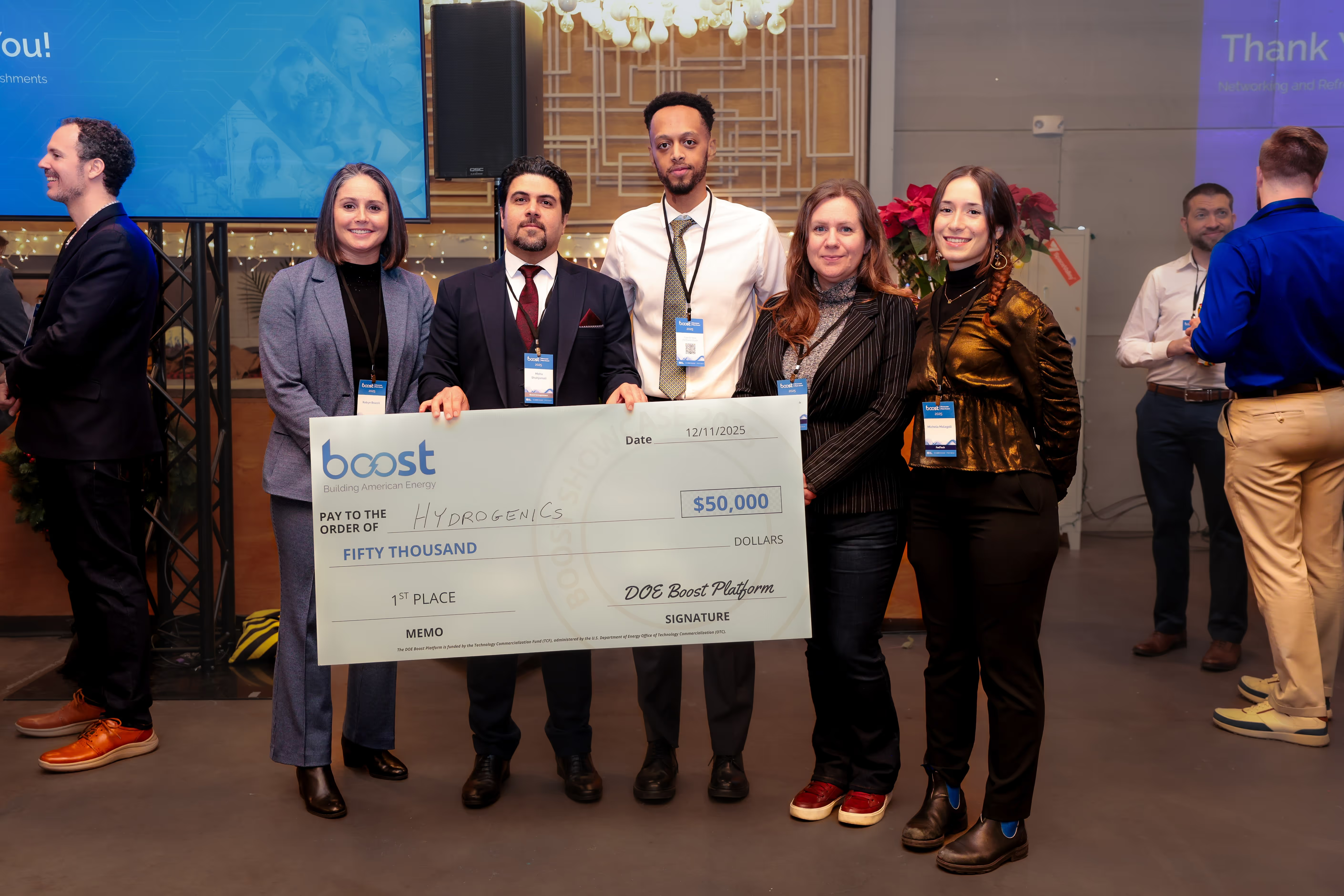
On December 11th, DOE Boost, a commercialization program led by Sandia National Laboratories and FedTech, concluded its 2025 cycle with the Boost Showcase, convening government and industry stakeholders to assess the transition readiness of startups built around lab-developed technologies. In doing so, the Showcase reflected a broader reality across the federal commercialization pipeline: for many validated technologies, the pace and quality of commercialization decisions now determine whether momentum carries forward or dissipates before real-world deployment.
The DOE Boost Showcase concludes the months-long DOE Boost program, which develops actionable commercialization strategies for technically validated, mission-aligned lab technologies. Through the program, teams of entrepreneurs establish clear plans for what comes next, defining execution priorities and transition pathways without presuming outcomes. The Showcase then brings together laboratories, sponsors, and potential partners to pressure-test strategies, identify gaps and opportunities, and advance conversations that shape transition.
This is the phase between technical validation and market entry when sponsors and laboratories assess whether a technology justifies continued institutional attention through licensing discussions, partnership exploration, or early deployment pathways. It is also the stage at which many promising technologies stall in the absence of structured commercialization support, not because the science falls short, but because readiness for next steps remains unresolved.
After Technical Validation: Where Commercialization Decisions Begin
Because core technical risk has already been addressed prior to program entry, through laboratory research and independent expert review, including diligence by FedTech, the Boost program period is focused on work beyond technical feasibility, grounding the teams’ plans in market and transition realities.
During the program, teams develop viable commercialization strategies for validated technologies by determining how those technologies could function as the foundation of a new venture. This work includes shaping licensing approaches, clarifying execution plans related to company formation, early deployment, and target use cases, as well as identifying the technical, regulatory, and organizational dependencies that will influence downstream transition. Teams also engage in early conversations with prospective users and partners to test assumptions about demand, use environments, and adoption pathways.
The objective of this work is not to secure commitments or predict outcomes, but to replace ambiguity with a credible and executable plan for transition.
What teams bring to the Showcase is a defined path, supported by a credible execution plan and informed by established commercialization playbooks and advisory input. This foundation enables the event to function as a meaningful evaluation moment, bringing together the right stakeholders to assess whether those paths are sufficiently defined to support next steps toward market entry.
A Deliberate Moment of Evaluation
Structured as a pitch-style event, the DOE Boost Showcase operates within the DOE commercialization pipeline as a forum for assessment, bringing together senior leadership from the U.S. Department of Energy (DOE), the DOE Office of Technology Commercialization (OTC), national laboratories, DOE program offices, and external stakeholders to examine whether solutions are positioned to advance beyond the program.
At the annual Showcase, teams of entrepreneurs present the commercialization paths they have developed throughout the program, with presentations focused on execution strategy rather than technical demonstration. This year’s Showcase reflected technologies aligned with DOE priorities across areas such as grid resilience, domestic energy and resource security, advanced manufacturing, and materials, anchoring assessments in defined mission contexts and the transition requirements that accompany them.
Rather than focusing solely on technical capability, founders’ presentations demonstrate transition readiness, allowing Showcase attendees to assess how breakthrough technologies, licensing paths, and execution plans may come together in practice.
Participation from across the commercialization ecosystem, including industry and early capital, reinforced the Boost Showcase as a point of alignment and judgment around commercialization readiness rather than exhibition. Opening remarks from Mary Monson (Sr. Manager, Technology Partnerships and Business Development, Sandia National Laboratories) and a keynote from Anthony Pugliese (Chief Commercialization Officer, U.S. Department of Energy, and Director of the DOE Office of Technology Commercialization) framed the discussion around stewardship and the responsible progression of validated research toward real-world use.
By design, the Showcase emphasizes soliciting quality feedback over showmanship. It provides a shared moment to surface remaining constraints and clarify what would be required to move forward responsibly once the program cycle concludes. As federal commercialization efforts evolve, progress increasingly depends on well-timed moments of assessment to support informed handoffs from validated technology to market-facing pathways.
Evaluation Unlocks Impact
When commercialization strategies are evaluated deliberately, downstream impact becomes more focused and more likely. For laboratories, agencies, and industry partners, the value of evaluation at the Showcase stage lies not in accelerating decisions, but in improving their quality. Rather than revisiting foundational questions, stakeholders can focus on whether and how specific pathways align with institutional objectives, risk tolerance, and resource availability.
This evaluative clarity enables more informed downstream engagement. For laboratories and technology transfer offices, it anchors licensing discussions in a defined commercialization context. For industry, capital partners, and DOE sponsors, it sharpens judgment about where engagement is warranted, distinguishing between technologies ready for next-stage coordination and those that require further maturation. Importantly, evaluation at this stage does not necessitate convergence around a single outcome or timeline. Rather, it reduces ambiguity, aligns expectations, and ensures that next steps, whether immediate or deferred, are better informed.
This is the downstream value of the DOE Boost Showcase. By clarifying viability at a critical moment, it helps ensure that movement toward the market is intentional, coordinated, and grounded in execution reality rather than assumption alone.
Looking Forward
As the Department of Energy continues to strengthen its commercialization architecture, clearly defined moments of evaluation will be as important as early-stage discovery and late-stage deployment mechanisms. The 2025 DOE Boost Showcase underscored a broader insight: evaluation at the right moment strengthens the path from validated research to real-world use. By presenting stress-tested, viable commercialization paths, the Showcase enables informed assessment and supports more effective downstream engagement across transition pathways.
For stakeholders interested in future DOE Boost cohorts or in how DOE is structuring clearer commercialization decision points across its portfolio, we welcome your continued engagement. To stay up to date on future DOE Boost activities, register your interest through this form.
.avif)
.avif)
.avif)