




Technical and Business Assistance (TABA) is funding tied to an SBIR or STTR award that pays for expert help with the business side of commercialization. It covers work such as market research, customer discovery, IP strategy, regulatory planning and cybersecurity readiness. Depending on the agency, TABA is added on top of your award or set aside within it.
If you hold an SBIR or STTR award, or are applying for one, this guide explains what TABA covers, how much is available, how the rules differ by agency, and how to choose a provider.
TABA in one minute
- What it is: funding tied to an SBIR/STTR award, for expert commercialization help
- Who can use it: small businesses with an SBIR or STTR award, if the awarding agency offers TABA
- What it covers: market research, customer discovery, IP strategy, regulatory and manufacturing plans, cybersecurity, marketing materials
- How much: up to $6,500 per Phase I project and up to $50,000 per Phase II project
- Who pays: the agency. At some it's added on top of your award; at others it comes out of your award total
- How to get it: usually by requesting it in your proposal. At some agencies, such as the Army, a provider hired by the agency contacts you
Why TABA exists
Many small companies win research awards, then stall when it's time to sell. The team knows the science, not the market or the paperwork. Congress created TABA so awardees can pay for business help with funds set aside for that purpose. The goal is a technology that reaches buyers, not just a finished report.
What changed in 2026
The law that reauthorized SBIR and STTR, signed April 13, 2026, updated TABA too:
- Limits are per project. Up to $6,500 per Phase I project and $50,000 per Phase II project, across all years.
- More ways to use it. You can hire outside providers, or use TABA to hire or train your own staff.
- Wider uses. Agencies now list cybersecurity and screening for foreign involvement alongside market and IP work.
Agencies are still updating their own rules, so check your current solicitation.
What TABA can pay for
Each agency publishes its own list. Common uses:
- Market research and customer discovery. Who will buy your technology, how big the market is, and what real buyers tell you.
- IP strategy. Protecting what you built, IP landscape reviews, and licensing advice.
- Regulatory and manufacturing plans. The approvals, standards and production steps between your prototype and a product.
- Cybersecurity. Including readiness for the CMMC rules that come with defense work.
- Marketing materials. Pitch decks, capability statements and product videos.
- Financial planning. Reviewing your financial plan and fundraising strategy.
What TABA usually does not pay for: your core research, the SBIR/STTR fee, and routine business costs. NASA and NIH, for example, exclude bookkeeping, payroll, general accounting and audits. You can't take TABA as cash.
How the rules differ by agency
The biggest differences: whether TABA is added on top of your award, when you must request it, and who picks the provider.
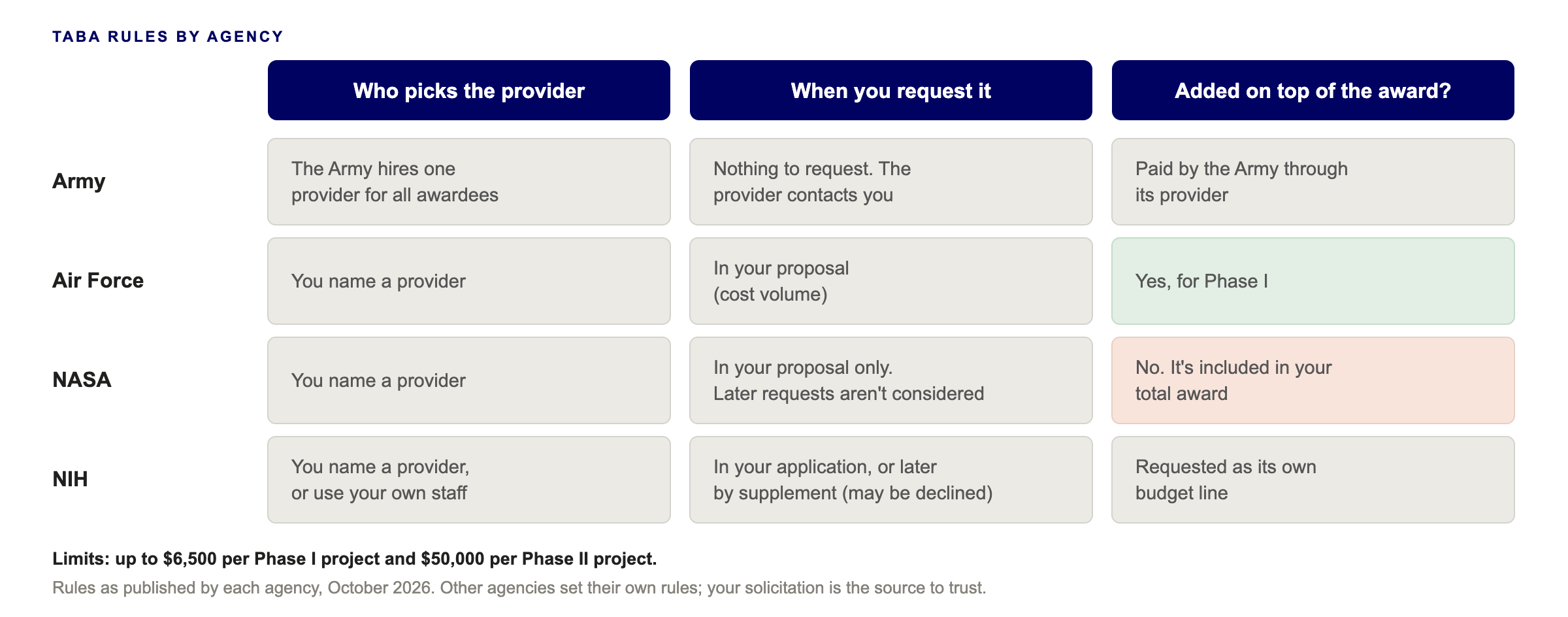
- Army: the Army hires one provider for all awardees. Nothing to request; the provider contacts you after award. Paid by the Army through its provider.
- Air Force: you name a provider and request TABA in your proposal's cost volume. Phase I TABA is added on top of the award.
- NASA: you name a provider and must request TABA in your proposal; later requests aren't considered. TABA is included in your total award.
- NIH: you name a provider or use your own staff. Request it in your application, or later by supplement (NIH may decline). It's requested as its own budget line.
Other agencies, including NSF, DOE and USDA, set their own rules. Your solicitation is the source to trust.
Two ways agencies deliver TABA
1. You choose a provider. Most agencies, including NASA, NIH and the Air Force, let you pick your provider and request the funding in your proposal. You'll usually need a quote from the provider that lists its qualifications, each service, its cost and the deliverables.
2. The agency hires one provider for everyone. Some agencies, including the Army, hire a TABA provider to serve all of their awardees. You don't need to request anything. The provider contacts you after your award.
How it works, step by step
- Win the award. If your agency has a provider, it gets the list of new awardees. If you chose your own, you named them in your proposal.
- Intake call. The provider learns about your technology, your customers and what would help most.
- Agree on a scope. A short statement of work lists the services, deliverables and timeline. You can combine several services.
- Do the work. Usually a few months, with check-ins at kickoff, midpoint and completion. The work must be finished within your award's period of performance.
- Close out. You get the final deliverables, the provider reports progress to the agency, and you're asked for feedback.
What we see as a TABA provider
FedTech delivers TABA for Army awardees and for awardees at other agencies. A few patterns stand out.
- The most requested services from Army awardees are CMMC readiness, government accounting setup, IP strategy, market research and product videos. Many companies combine several in one engagement.
- Tie the request to a specific gap. "We don't know who buys this" or "we have no IP plan" leads to better work than a general request for "commercialization support."
- Use Phase I TABA to build your Phase II case. Phase II proposals ask for a commercialization plan. Market research and customer interviews done in Phase I feed it directly.
- Start early. The work has to be delivered within your award period. Engagements that begin in the last few weeks get squeezed.
- Asking for TABA doesn't hurt you. At NASA, for example, TABA requests are reviewed only after selection and don't affect your proposal's score.
How to choose a TABA provider
If your agency lets you choose, the provider you name matters. There is no official list of approved providers. Before you decide, check:
- Are they eligible? NASA, for example, requires a U.S. business that isn't your company, an employee, an affiliate or an investor.
- Do they already work with your agency? Providers your agency knows understand the process and the paperwork.
- What will you get at the end? Ask for a sample deliverable, not only a list of services.
- Who does the work? Find out who your contact is and what their background is.
- Will it finish in time? The timeline must fit your award period.
- Do they take equity or IP? FedTech doesn't. We take no equity and hold no IP, so our only goal is your commercial success.
What this looks like in practice
FedTech is the TABA provider for U.S. Army SBIR and STTR awardees. We also provide TABA for awardees at other agencies, including NASA and NSF, who name us in their proposals. Awardees tell us what changes.
"The work done by FedTech far surpasses what we have received previously by any other TABA provider." — Design Interactive, Army Phase II SBIR awardee
"We were accepted for our very first Phase 2! This is a direct result from our most recent Phase 1 engagement." — Neurable, Army SBIR Phase I awardee
Applying for an SBIR or STTR award, or just won one? See our TABA services page to request a provider quote for your proposal or start an engagement.
Frequently asked questions
What does TABA stand for?
Technical and Business Assistance.
How much TABA funding can I get?
Up to $6,500 per Phase I project and up to $50,000 per Phase II project. Your agency may set lower limits.
Does TABA come out of my research budget?
It depends on the agency. Some add TABA on top of your award. Others, such as NASA, include it in your total award, so it reduces what's left for research.
Can I get cash instead of services?
No. TABA pays for specific services, from a provider or, at some agencies, from staff you hire or train for the purpose.
Can I add TABA after I've won my award?
It depends on the agency. At many, including NASA, it must be in your proposal. NIH accepts later requests by supplement but may decline them.
Can I pick my provider?
At most agencies, yes: you name your provider in your proposal. At agencies that hire one provider for all awardees, such as the Army, that provider works with you.
Is there a list of approved TABA providers?
No. Agencies don't keep or endorse one. Check your agency's eligibility rules and ask providers for qualifications and sample deliverables.
Will asking for TABA hurt my proposal?
Not at NASA, where requests are reviewed only after selection. Check your agency's rules.
What if I already have a lawyer or accountant?
TABA can still help. Providers often work alongside your existing advisors rather than replace them.
What do I get at the end?
The deliverables agreed in your statement of work, such as a market research report, an IP strategy, or a CMMC readiness plan.