




SBIR commercialization means turning the research an SBIR or STTR award pays for into a product that government agencies or companies buy. The award funds the science. Commercialization is everything else: finding the buyer, proving they will pay, setting a price, and lining up the next round of money, whether from a Phase III contract, a corporate partner or investors.
Help is available for each of those steps. Technical and Business Assistance (TABA) funding, attached to many awards, pays outside experts for market research, customer discovery and pricing work. Agency programs, accelerators and commercialization partners like FedTech fill the gaps. This guide walks through what to do at each phase and where to get help.
SBIR commercialization in one minute
- The goal: a paying customer, not a final report.
- Phase I: prove the technology can work, and prove someone needs it.
- Phase II: build the prototype, and line up the buyer and the next funding source.
- Phase III: sell. Paid for by an agency program, a prime contractor, a company or investors, not SBIR funds.
- Where most companies stall: between Phase II and Phase III, when SBIR money ends and no buyer is ready.
- Where to get help: TABA, agency commercialization programs, accelerators and commercialization partners.
Why good technology still stalls
Most SBIR companies are founded by scientists and engineers. They know their technology better than anyone. What they often don't have yet is a clear answer to three questions:
- Who exactly will buy this? A specific office, program or company, not "the Army" or "the energy sector."
- What will they pay, and from which budget? A program manager who likes your demo may not have money for it.
- What funds the gap? Phase II ends long before most buyers can sign a contract.
Companies that answer these during Phase I and Phase II move faster. Companies that wait until the award ends often run out of time and money. Since reauthorization in 2026, agencies are also looking harder at whether past awards led anywhere, so commercialization progress now affects your chances of winning the next award too. (More on that in SBIR and STTR Are Back, But the Bar Is Higher.)
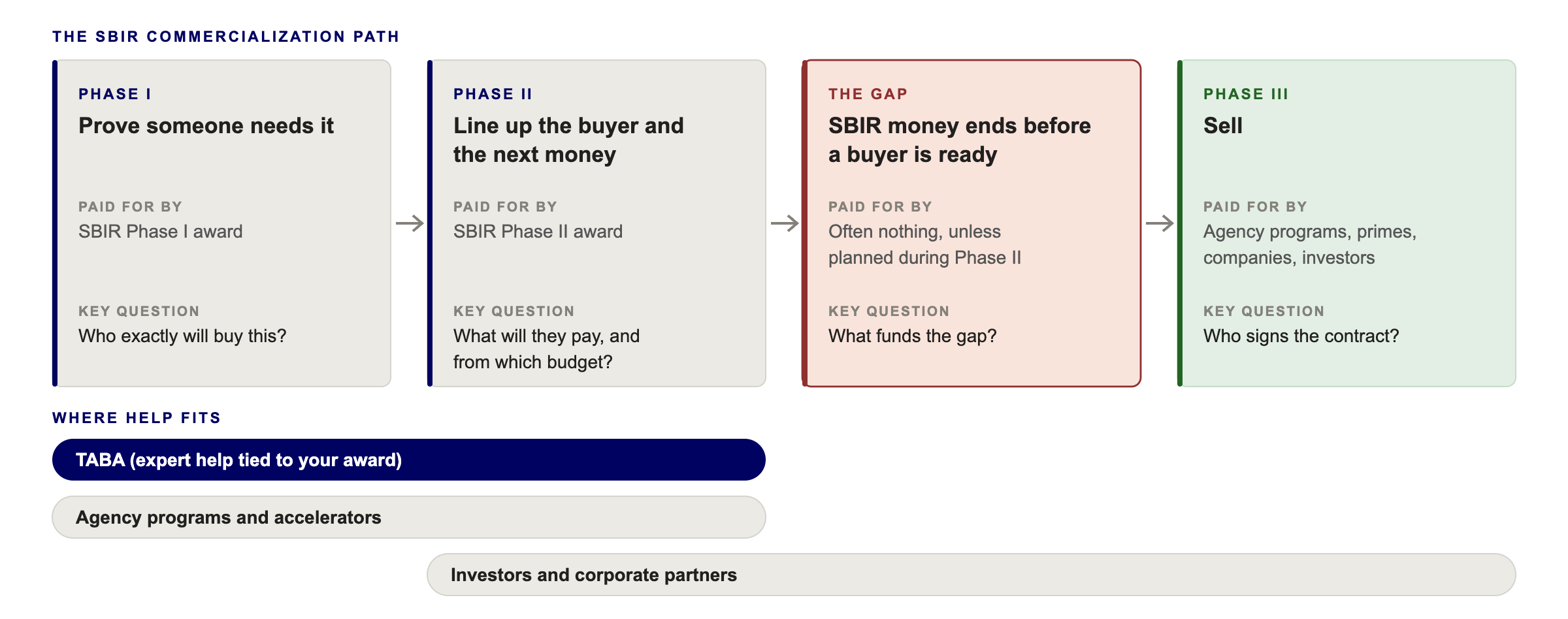
Commercialization by phase
Phase I: prove someone needs it
Phase I is short and small. Use it to test the market as hard as you test the technology.
- Talk to buyers early. Aim for real conversations with the people who would use, approve and pay for your product. Write down what they say, especially the objections.
- Find the money trail. Learn which program office or budget line would pay for your technology, and when.
- Write a commercialization plan you can defend. Reviewers can tell the difference between a plan built on interviews and one built on market reports.
- Ask about TABA now. Many agencies let you request it in your proposal. See What Is TABA?
Phase II: line up the buyer and the next money
Phase II is the bigger award. It is also your last SBIR-funded chance to set up what comes next.
- Turn interest into commitment. A letter of support, a pilot, a cooperative agreement or a signed test plan is worth more than a good meeting.
- Set your price. (See "Pricing" below.)
- Map Phase III. Identify the program, prime contractor or company that could fund the next step, and what they need to see first.
- Start talking to investors before you need them. Fundraising takes months. Begin while Phase II is still paying the bills.
- Know the bigger options. Under the 2026 law, agencies with large SBIR budgets can make "Strategic Breakthrough" Phase II awards of up to $30 million for technologies that need more than a normal Phase II to mature.
Phase III: sell
Phase III is any work that builds on your SBIR research and is paid for with non-SBIR money. It can be a government contract, a sale to a prime contractor, or a commercial product.
- Phase III has advantages. Agencies can often award Phase III work without a new open competition, because the earlier phases already went through one. Many buyers don't know this. Be ready to explain it.
- Commercial sales count. Phase III isn't only government work. A company buying your product, or investors funding your growth, also counts.
- Protect your data rights. SBIR awards come with data rights protections. Know what they cover before you share technical data with a partner.
The three things buyers ask about
These are where SBIR companies most often ask for help.
Customer discovery. Structured interviews with the people who would use, approve and pay for your product. The output is evidence: who needs it, how badly, what they use today, and what would make them switch. Government customer discovery has its own twist: the user, the person who approves the purchase and the person who controls the budget are usually different people.
Marketing. For most SBIR companies, marketing means being findable and credible to a small number of buyers: a clear one-line description, a website that says who you serve, a short capability statement, and a reason to meet at the right conferences. It rarely means big campaigns.
Pricing. Set price from the buyer's side: what does the problem cost them today, and what do comparable products cost? Then check it against your own costs and margins. For government buyers, also learn how they buy (contract types, purchase limits, timing in the budget year), because those rules shape what price will actually get approved.
Where SBIR companies can get commercialization help
- TABA: agency-funded outside experts for market research, customer discovery, IP, pricing and regulatory work. Usually nothing out of pocket.
- Agency programs: many agencies run their own commercialization training, mentoring or matchmaking for awardees. Usually free.
- Accelerators: cohort programs with mentors, investor access and demo days, often focused on one agency or sector. Costs vary; some take equity.
- Commercialization partners: firms that run customer discovery, market and pricing work, and transition planning alongside you. Often paid through TABA.
- Investors and corporate partners: capital and routes to market, especially for Phase III. Paid in equity or deal terms.
One question to ask any provider: do they take equity or IP? FedTech doesn't. We work as a service, so our only stake is your success.
How FedTech helps SBIR companies
FedTech has delivered 136+ commercialization programs since 2015, and the companies we've worked with have raised $5.7B. For SBIR and STTR companies, that work includes:
- TABA for Army SBIR/STTR awardees, and for awardees at other agencies, including NASA and NSF, who name us in their proposals: market research, customer discovery and commercialization strategy. See TABA services.
- Accelerators run on behalf of federal agencies, connecting SBIR companies with the program offices and partners that buy.
- Startup studios that form new companies around federal lab technologies, many of which go on to win SBIR awards.
"We were accepted for our very first Phase 2! This is a direct result from our most recent Phase 1 engagement." — Neurable, Army SBIR Phase I awardee
Direct Kinetic Solutions, formed in a FedTech Startup Studio, went on to win an NSF SBIR award and an Air Force Phase II. Read their story.
Have an SBIR or STTR award? Talk to our team about commercialization support.
Frequently asked questions
What does commercialization mean for an SBIR award?
Turning the research the award paid for into a product or service that customers buy, whether those customers are government agencies, prime contractors or companies.
What is SBIR Phase III?
Work that builds on your SBIR research and is paid for with non-SBIR money, such as a government contract, a sale to a prime contractor, or commercial sales.
Can a government agency award Phase III without competition?
Often, yes. Because the earlier phases were competed, agencies can usually award Phase III work directly to the SBIR company. Check with your contracting officer.
When should I start planning for commercialization?
At Phase I. Agencies increasingly look at commercialization progress when deciding later awards, and Phase II ends long before most buyers are ready to sign.
What programs help SBIR companies with customer discovery, marketing and pricing?
TABA funding, agency commercialization programs, accelerators and commercialization partners. TABA is often the best place to start, because the agency usually pays for it.
Do investors care about SBIR awards?
Many do. An SBIR award is non-dilutive funding and outside validation of your technology. Investors will still ask the same questions as any buyer: who pays, how much, and how soon.
What is the difference between SBIR and STTR?
STTR requires the small business to work formally with a research institution, such as a university or federal lab. SBIR does not. Commercialization works the same way for both.